Identity
What intersex means: natural variations in sex characteristics, rights and respectful language
A clear guide to intersex variations, why estimates of how common they are differ, the debate over surgeries on children, and how to talk about intersex people with respect.
Intersex people are born with sex characteristics that do not fit typical definitions of male or female bodies. Sex characteristics include chromosomes, hormones, internal organs such as ovaries and testes, and external genitals. In an intersex person, one or more of these develop in a way that does not match the standard medical picture of a “male” or “female” body.
Being intersex is a natural part of human variation. It is not a disease, a gender identity or a sexual orientation. Most intersex people live healthy lives, and many find out they are intersex only later in life, or never. The main problems intersex people face usually come not from their bodies, but from secrecy, shame and medical decisions made without their consent.
A short definition in plain words
School biology often teaches two boxes: XY chromosomes, testes and a penis on one side; XX chromosomes, ovaries and a vagina on the other. Real bodies are more varied. Some people have XY chromosomes and a body that does not respond to testosterone, so they develop a typically female appearance. Some have XXY chromosomes. Some have ovaries and genitals that look partly typical of males. Some have a mix of ovarian and testicular tissue.
There are dozens of different intersex variations. Some are visible at birth. Some appear at puberty, for example when periods do not start or when a body changes in unexpected ways. Some are only discovered during fertility tests, during an unrelated operation, or not at all.
How common is it?
You will see different numbers, and the reason is the definition used.
| Definition | Approximate frequency | What it includes |
|---|---|---|
| Broad | Up to about 1.7% of births | Many variations, including some that are never noticed without tests |
| Visible at birth | Around 1 in 2,000 births, depending on the source | Genitals that doctors describe as clearly atypical |
| Narrow medical | Much lower | Only certain specific conditions |
The broad figure, often quoted by the United Nations Free & Equal campaign, is similar to the share of people born with red hair. Even the narrower estimates mean that intersex people live in every country, in large numbers. The point is not to win an argument about the exact percentage. It is to recognise that bodies outside the two-box model are not rare curiosities.
Words people use
Intersex is the term preferred by most intersex-led organisations. It describes a group of people with a shared experience, much like other identity words.
Differences (or disorders) of sex development, or DSD, is a medical term introduced in 2006. Some doctors and some families use it. Many intersex activists criticise “disorder” because it presents natural variations as illnesses to be corrected. If a person uses one term for themselves, follow their choice.
Hermaphrodite is an old word that is now considered inaccurate and offensive when applied to humans. It comes from biology and mythology and suggests a person has two complete sets of organs, which is not what being intersex means.
Some people also use the names of specific variations, such as androgen insensitivity syndrome, Klinefelter syndrome or congenital adrenal hyperplasia. Not everyone with these variations calls themselves intersex. Some see it simply as a medical fact about their body.
Intersex is not a gender identity
Being intersex is about the body. Gender identity is about a person’s own sense of who they are. Most intersex people identify as men or as women. Some are nonbinary. Some are trans, because the sex they were assigned at birth, often by doctors, does not match their gender. Intersex people can also be straight, gay, lesbian, bisexual or any other orientation.
Intersex is part of the LGBTQIA+ acronym, the I, because intersex people face similar pressure to fit rigid ideas about sex and gender, and because the movements have worked together. Some intersex people feel at home in queer spaces. Others do not, and prefer to be seen simply as people with a particular body. Our guide to what LGBTQIA+ means explains how different letters share the acronym without sharing every experience.
The debate over surgeries on children
For much of the twentieth century, doctors in many countries followed a model that treated intersex bodies as problems to fix quickly. Babies and young children with atypical genitals often had surgery to make their bodies look more typically male or female. Parents were sometimes told to hide the truth, and children were often not told what had been done to them.
Many intersex adults who went through this describe lasting harm: scarring, loss of sensation, infertility, repeated operations, trauma from examinations and the pain of discovering secrets about their own bodies. Some were assigned a sex that did not match the gender they grew into.
Today, intersex-led organisations, the United Nations human rights system and a growing number of doctors argue that medically unnecessary surgery on intersex children should wait until the person can understand and decide for themselves. This is different from urgent treatment. Some intersex variations come with health needs, such as hormone problems that require care, and those should be treated. The question is about operations done mainly to change appearance.
Malta became the first country to ban non-urgent surgery on intersex children without their informed consent in 2015. Several other countries have since introduced similar protections, including Portugal and Germany, while in many places the practice continues. Laws and hospital guidelines change, so families should ask about current rules and seek a second opinion before agreeing to any non-urgent procedure.
If your child is intersex
Learning that your baby or child has an intersex variation can be confusing, especially if doctors use alarming language. A few principles help:
- Ask which treatments are urgent for health and which are not. Get clear answers about what would happen if you waited.
- Ask for a second opinion, ideally from a team with experience of intersex variations and psychological support.
- Seek contact with intersex-led groups and other families. Hearing from adults who share your child’s variation is often more reassuring than any brochure.
- Avoid secrecy. Children usually cope better when they learn about their bodies gradually and honestly, in age-appropriate language.
- Let your child grow into their own identity. A sex is recorded at birth, but your child’s gender identity will become clear as they grow, as it does for every child.
How to talk about intersex people with respect
Use “intersex” as an adjective. Say “an intersex person” or “intersex people”, not “an intersex”.
Do not ask about genitals or medical history. An intersex person’s body is as private as anyone else’s. If they choose to share details, listen; if not, do not push.
Do not use intersex people as a debating tool. Intersex people are sometimes mentioned in arguments about trans rights or sport, often by people who know little about them. They are real people with their own needs, not examples to win a point.
Believe people’s own accounts. Some intersex people are proud and open. Some are private. Some feel anger about what happened to them. All of these reactions make sense.
Avoid surprise and pity. Statements like “I never would have guessed” or “that must be awful” put the person in an awkward position. A simple “thank you for telling me” is better.
Dates and symbols
- 26 October is Intersex Awareness Day. It marks the first public intersex protest, held in Boston in 1996.
- 8 November is Intersex Day of Remembrance, the birthday of Herculine Barbin, a nineteenth-century French intersex person whose memoirs became an important historical document.
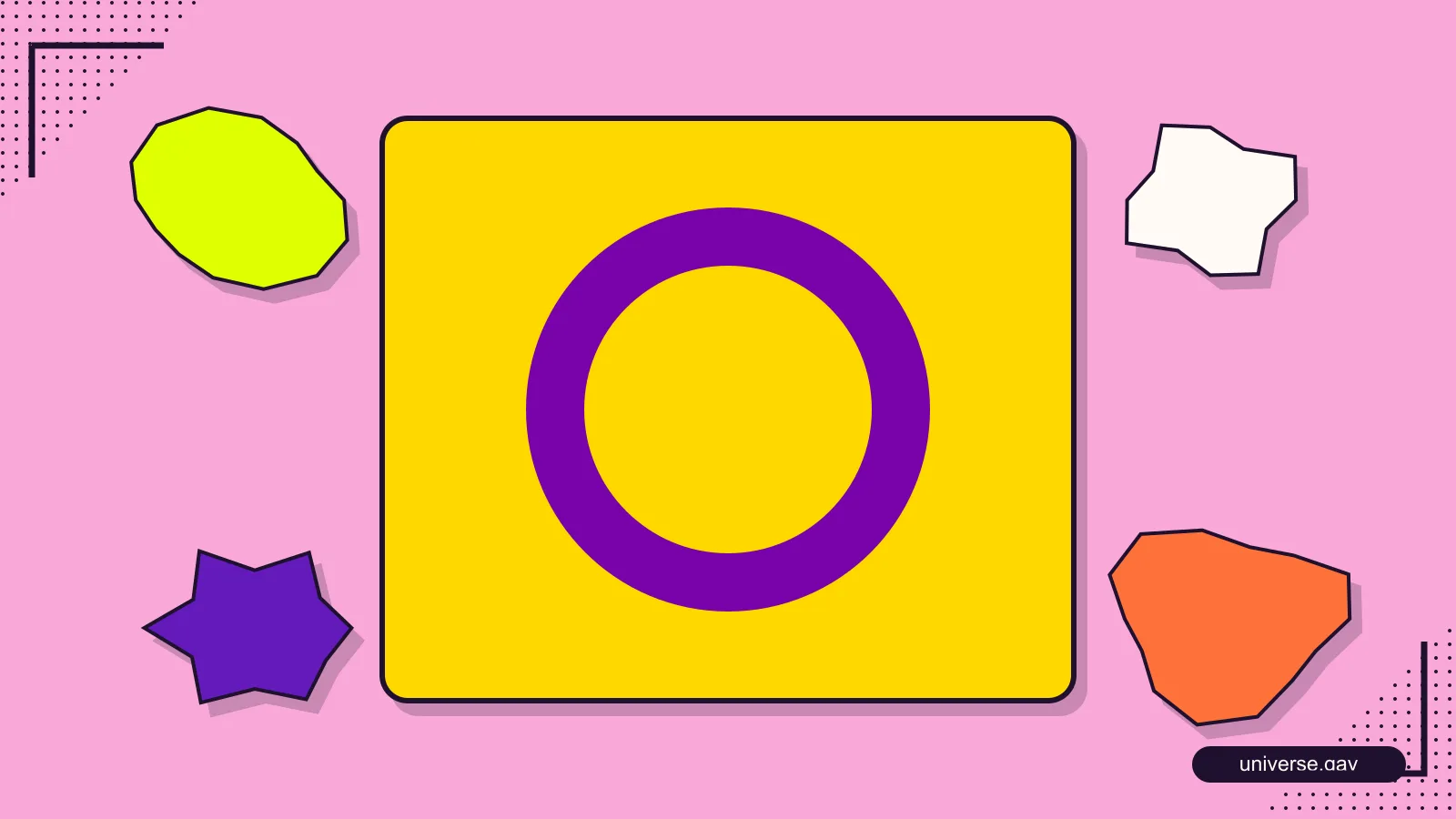
- The intersex flag, designed in 2013 by Morgan Carpenter of Intersex Human Rights Australia, is yellow with an unbroken purple circle. The colours were chosen to avoid the blue and pink associated with gender, and the circle represents wholeness and the right to decide about one’s own body.
Our guide to Pride flags explains how other community flags were created.
The main idea
Intersex variations show that human bodies do not always fit neat categories. The respectful response is not to force them into one, but to protect intersex people’s privacy, health and right to decide about their own bodies. Most of what intersex people ask for is simple: honesty, consent and the same dignity as everyone else.